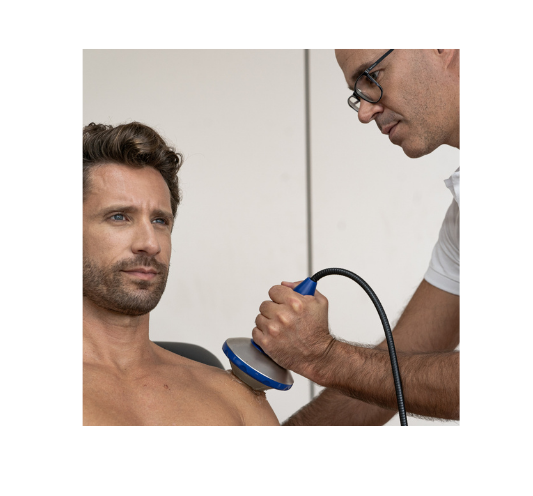
Shockwave Therapy in Chadstone and Box Hill: Radial vs Focused Explained
If you’ve been searching for shockwave therapy in Chadstone or Box Hill to help with a stubborn tendon, joint or heel problem, you’ve likely come across two terms that sound similar but describe very different treatments: radial shockwave and focused shockwave. Both are delivered under the Swiss DolorClast® system by EMS (Electro Medical Systems), a Swiss manufacturer widely regarded as a global leader in extracorporeal shockwave therapy (ESWT). At Cornerstone Medical Group, our Melbourne clinics use both technologies, because choosing the right one can be the difference between a stalled recovery and lasting relief.
What Is Shockwave Therapy?
Shockwave therapy, or ESWT, is a non-invasive treatment that delivers acoustic pressure waves into injured tissue. These waves trigger a cascade of biological responses:
- Reduced pain, partly through modulation of substance P
- Improved local blood flow (neoangiogenesis)
- Activation of stem cells and accelerated tissue repair
- Breakdown of calcific deposits in chronic tendinopathies
Shockwave therapy is clinically proven across a wide range of musculoskeletal conditions and is often the next step when conservative care such as physiotherapy, injections or medication hasn’t delivered results.
Radial Shockwave Therapy (rESWT) Explained
Radial shockwave was pioneered and patented by EMS in 1997 and remains the most widely used form of ESWT in musculoskeletal practice today.
How Radial Shockwave Works
Radial waves are generated ballistically. Compressed air propels a projectile inside the handpiece at speeds of up to 90 km/h, striking a fixed applicator. The resulting kinetic energy converts into a pressure wave that enters the skin and spreads outward in a divergent, radial pattern. Energy is highest at the skin surface and dissipates with depth.
Conditions Treated with Radial Shockwave
Because radial waves cover a broad, superficial area, they’re ideal for structures close to the skin:
- Plantar Fasciitis and heel spurs (https://pubmed.ncbi.nlm.nih.gov/38738305/)
- Mid-portion Achilles tendinopathy
- Tennis elbow and golfer’s elbow (https://www.ncbi.nlm.nih.gov/pmc/articles/PMC7106907)
- Trigger points and myofascial pain
- Patellar tendinopathy
- Muscle tears and spasticity
Focused Shockwave Therapy (fESWT) Explained
Focused shockwave complements radial by reaching structures that a divergent wave simply can’t.
How Focused Shockwave Works
Focused waves are generated by a different physical mechanism (typically electromagnetic in EMS focused devices) and behave in the opposite way to radial waves. Rather than dispersing outward, the wavefront converges at a precise focal point beneath the skin, creating a small, cigar-shaped focal volume. The compression phase is shorter and the peak pressure is higher than radial ESWT, delivering more concentrated energy at depth.
Conditions Treated with Focused Shockwave
Focused shockwave is the preferred tool for deeper or more precisely localised pathology:
- Deep calcific tendinopathies (for example, supraspinatus calcifications)
- Rotator cuff pathology
- Delayed or non-union fractures
- Deep enthesopathies unresponsive to radial treatment
- Chronic, deep-seated lesions
- Bony pathology such as stress reactions
Radial vs Focused Shockwave: Key Differences at a Glance
| Feature | Radial Shockwave (rESWT) | Focused Shockwave (fESWT) |
|---|---|---|
| Wave generation | Ballistic (compressed air) | Electromagnetic |
| Energy distribution | Divergent, spreads outward | Convergent, meets at focal point |
| Depth of penetration | Superficial (up to about 4 cm) | Deeper (up to about 12 cm) |
| Peak pressure (P+) | Lower | Higher |
| Treatment area | Broad | Precise and targeted |
| Best suited to | Superficial soft tissue | Deep calcifications and bone |
Which Shockwave Therapy Is Right for You?
The honest answer is that it depends on your diagnosis. Comparative research, including double and triple-blind RCTs by Stania et al. (2021) and Schmitz et al. (2015), shows no significant difference in clinical outcomes between radial and focused devices, provided the target tissue is adequately reached. In other words, both work. The clinical skill lies in matching the technology to the anatomy.
As a general rule:
- Choose radial shockwave for superficial tendon and muscle problems.
- Choose focused shockwave for deep calcifications, bony pathology, or lesions that haven’t responded to radial treatment.
- Many complex cases benefit from a combined approach across a single treatment plan.
At Cornerstone Medical Group, our practitioners are trained in the Guided DolorClast Therapy (GDT) protocol and will select the technology (or combination) best suited to your presentation.
Conditions We Commonly Treat with Shockwave Therapy
Our Chadstone and Box Hill clinics use EMS shockwave therapy as part of a wider non-surgical care plan for:
- Neck pain and cervical trigger points
- Low back pain and gluteal tendinopathy
- Shoulder, elbow and wrist pain, including rotator cuff and tennis elbow
- Hip, knee, ankle and foot pain, including plantar fasciitis and Achilles tendinopathy
- Sports injuries and chronic overuse conditions
Learn more about our
EMS Shockwave Therapy service and how it fits alongside chiropractic, physiotherapy, laser therapy and spinal decompression.
Book Shockwave Therapy in Chadstone or Box Hill
Cornerstone Medical Group offers EMS Swiss DolorClast® shockwave therapy at two convenient Melbourne locations:
Cornerstone Medical Group Chadstone
Suite 7, Level 2, UL40, 1341 Dandenong Road, Chadstone VIC 3148 (Waterman @ Chadstone Shopping Centre)
Serving Malvern East, Oakleigh, Ashwood, Mount Waverley, Hughesdale, Carnegie and surrounding suburbs.
Phone: 03 8564 8611 or 0470 365 972
Book an appointment online
Cornerstone Medical Group Box Hill
Boxhill Sky Square, Box Hill VIC
Serving Blackburn, Mont Albert, Balwyn, Surrey Hills, Doncaster, Kew, Camberwell and surrounding suburbs.
Phone: 03 98752517
Book an appointment online
If you’ve been struggling with a stubborn tendon, joint or bony injury and want a non-surgical option backed by strong clinical evidence, our team is here to help you move better and live pain-free.